Engineering
Nine years of work, thirty-eight grams
A 14 TOPS neural engine that runs on harvested energy, a polariser-free micro-LED display, and sixteen sensors reading continuously. This is what is underneath.
The core
A neural engine built for one body
General-purpose silicon is wasteful when you already know the workload. Our core does four things — sequence prediction, anomaly detection, sensor fusion and identity matching — and does nothing else. Cutting everything we did not need is what let us get inference down to a power budget the wrist can actually generate.
The models are quantised to four bits and live permanently in on-die memory. There is no round trip, no queue and no server. The watch answers in eleven milliseconds whether or not it has ever seen a network.
- 14TOPS
- On-device inference
- 0.4W
- Peak draw under load
- 3.2mm²
- Die area
- 0
- Requests sent off-device
Sensing
Six systems, one continuous picture
Individually, none of these readings mean much. Fused and compared against months of your own history, they become the difference between a number and an insight.
Photoplethysmography
6 channelsGreen, red and infrared at two depths for heart rate and blood oxygen
Bioimpedance
4 electrodesHydration and body composition, sampled every twenty minutes
Inertial
9 axesAccelerometer, gyroscope and magnetometer for gait and gesture
Skin thermistors
2 pointsCase-side and skin-side, differenced to cancel ambient drift
Ambient light
3 spectraVisible, ultraviolet and infrared for display and circadian tracking
Barometric
1Altitude to 0.3 m, and the fall detection that depends on it
Display
Legible everywhere, intrusive nowhere
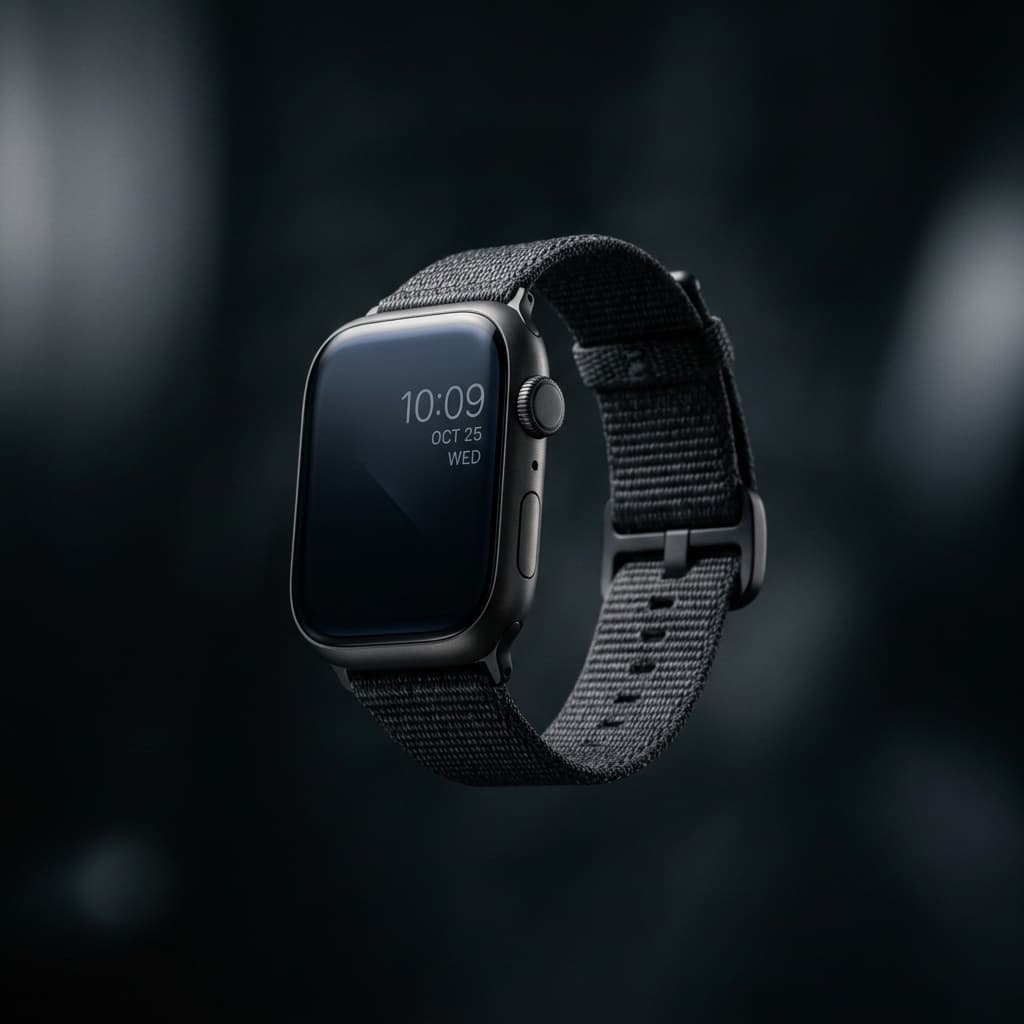
A 1,500:1 brightness range on a screen the size of a stamp, driven entirely by the ambient sensor. You will never adjust it.
2 to 3,000 nits
The same panel that is readable on a glacier at noon drops low enough to check the time at 3 a.m. without waking anyone.
One pixel at a time
Micro-LED emitters switch individually, so a mostly dark face costs almost nothing to hold. This is why always-on is genuinely always on.
No polariser
Removing the polarising layer gained us 22% brightness and lost nothing, because the emitters do not need it. It is also why blacks read as true black rather than dark grey.
Energy
The budget closes
A charger is an admission that a device spends more than it earns. Ours does not, so we did not ship one.
Solid-state cell
No liquid electrolyte, so no swelling and no thermal runaway. It holds 90% capacity after 3,000 cycles.
40-day reserve
Left in a drawer with no light and no movement, it keeps time for forty days before sleeping.
Replaceable at year eight
Cells age. Ours is a service part, not a sealed unit — swapped in twenty minutes at any service point.
Validation
Everything is broken before anything ships
Every batch is sampled and run through the full protocol. These are the tests, and these are the numbers we hold ourselves to.
Thermal cycling
−40°C to +85°C
500 cycles, checking for seal fatigue at every joint
Salt fog
720 hours
Twice the marine standard, because titanium is only as good as its coating
Drop
1.8 m onto steel
Twenty-six orientations, the same protocol we use for field instruments
Abrasion
10,000 strokes
Alumina slurry across the crystal and the case flank
Pressure
12.5 bar
Held for four hours, then cycled to simulate repeated dives
Sweat corrosion
90 days
Synthetic perspiration at 37°C against every exposed surface
Making
Six stages, two continents, nineteen days
From billet to boxed. Nothing about this is fast, and that is the point.
- 01Solothurn
Billet to case
A solid titanium billet spends four hours on a five-axis mill and leaves as a case weighing 16% of what it started at.
- 02Solothurn
Finishing
Bead-blast, vapour deposition or nine stages of hand polish, depending on the model. The longest of the three takes eleven days.
- 03Rubtsovsk
Crystal
Sapphire boules are cut, lapped to 0.9 mm and coated. Two in nine are rejected for inclusions you would never see.
- 04Hsinchu
Module
Neural core, sensor array and display are bonded into a single sealed module in a class 100 room.
- 05Solothurn
Assembly
Module, harvester and case are married by hand. Every watch is signed by the person who closed it.
- 06Solothurn
Proof
Pressure, accuracy and sensor calibration on every single unit, not a sample. Two hours per watch.
Research
Nine years before anyone could buy one
The first prototype was the size of a paperback and needed mains power. Getting from there to a wrist meant solving on-device inference and energy harvesting at the same time, because neither is useful without the other.
We publish what we learn. Every paper behind the sensor fusion work is open access, and the harvesting patents are licensed royalty-free to anyone building medical devices.
- 9
- Years from first prototype to first shipment
- 41%
- Of headcount in research rather than product
- 3
- Labs — Zurich, Kyoto and Cambridge
- 17
- Peer-reviewed papers published, all open access
Intellectual property
Six filings that made this possible
Listed because they are public record, and because the two marked royalty-free are the ones we most want other people to use.
EP 3 942 118
Kinetic energy recovery in a sealed horological housingRoyalty-free
Granted 2021
US 11 604 337
Continuous biometric identity verification from pulse morphology
Granted 2023
US 11 887 209
Quantised sequence prediction on sub-watt neural accelerators
Granted 2024
EP 4 118 552
Polariser-free micro-LED stack for high-ambient wearables
Granted 2024
WO 2025/041882
Differential thermal sensing across a conductive caseRoyalty-free
Pending
WO 2025/077410
On-device baseline drift correction for longitudinal health signals
Pending
The two energy-harvesting patents are licensed royalty-free for use in certified medical devices. Write to licensing and we will send the paperwork the same week.
What comes next
Committed dates, and honest ones
Anything we have not started is not on this list. Where a date depends on a regulator, we have said so instead of guessing.
Shipping now
First production run
One thousand watches across all three models, hand-assembled in Solothurn.
Q3
Sleep architecture
Stage-level sleep from the existing sensor array. A software update, not new hardware — every watch already shipped gets it.
Q4
Open sensor API
Read your own raw signals on your own machine, with a local export format that is documented and not ours to change.
Next year
Atrial fibrillation screening
In regulatory review in the EU and the US. It will ship when it is cleared and not before.
Specifications
Everything, in one place
Compute
- Neural engine
- 14 TOPS, 4-bit quantised, on-die model storage
- Memory
- 8 GB unified, 64 GB storage
- Inference latency
- 11 ms typical, 34 ms worst case
- Connectivity
- Bluetooth 5.4, Wi-Fi 6, UWB, optional eSIM
Display
- Panel
- Micro-LED, polariser-free
- Size
- 1.5 in (41 mm case) · 1.7 in (45 mm case)
- Brightness
- 2–3,000 nits, automatic
- Refresh
- 1–120 Hz variable
Power
- Cell
- Solid-state, 320 mWh, serviceable
- Harvesting
- Kinetic, photovoltaic and thermoelectric
- Reserve
- 40 days at rest
- Charging port
- None
Physical
- Case sizes
- 41 mm and 45 mm
- Thickness
- 9.8–10.1 mm by model
- Weight
- 38–42 g by model, without strap
- Water resistance
- 100 m, ISO 22810
- Operating range
- −20°C to +50°C
Partners
We did not do this alone
Six institutions did work we could not have done ourselves. Naming them is the least we owe.
ETH Zürich
Sensor fusion research and the gait model behind fall detection
Fraunhofer IIS
Thermoelectric harvesting, and the differential thermal patent
Seto Ceramic Works
Zirconia forming and the nine-stage polish for Pearl
Institut Horloger Solothurn
Case machining, final assembly and per-unit proofing
Kyoto Photonics
Polariser-free micro-LED stack development
Cambridge Sleep Group
Independent validation of the sleep staging model
Nine years of work, 38 grams on your wrist
The first production run is a thousand watches. Reserve one with a refundable deposit, or read the papers first — both links go somewhere real.